Then as now: Fascism as the battering ram of German monopoly capital
90 years after Hitler came to power, 84 years after the start of the Second World War, German imperialism is once again using fascism as a spearhead against Russia.
German imperialism is once again waging war against Russia in Ukraine. This war has been gradually prepared by the Federal Republic of Germany and NATO since the counter-revolution of 1989-91, and is in line with the two world wars started by Germany: the goal of German imperialism remains to expand its sphere of influence in Eastern Europe and, if necessary, to destroy Russia for this purpose. It seeks to achieve its goals militarily, primarily through NATO, and politically and economically through the EU. From the outset, German imperialism has also helped build up and made use of fascist forces for this purpose. The fascists play with the terror and violence they spread, but they also play an important role in Ukraine’s domestic politics. They are the most effective means of combating the opposition and the structures of the working class. In addition, they are the most active in promoting aggression against everything Russian. Since the Maidan coup in 2014, at the latest, German politicians have also been openly supporting fascists in Ukraine again.
In Germany, aggressive policy toward Russia has become apparent again with the start of the Russian military operation in Ukraine in February 2022. The bourgeois parties are outdoing each other in war cries and demands for rearmament—the delivery of modern battle tanks was only a matter of time. The Greens are particularly prominent as warmongers. Their belligerence inevitably brings back memories of the former foreign minister of the red-green federal government, Joschka Fischer (Greens), who justified the Federal Republic’s participation in the war of aggression against the former Yugoslavia with the exclamation „Never again Auschwitz“. And it is once again a Green foreign minister who is now talking about a victorious peace and the total defeat of Russia, admitting that we are at war with Russia and are happy to resort to fascist forces in Ukraine to achieve this. This also makes it possible for former ambassador Melnyk, a declared supporter of Ukrainian fascists, to speak in the German Bundestag and for „Slava Ukrajini,“ the battle cry of mass murderers of Jews, Russians, Poles, Roma and communists, to be normalised again.
Meanwhile, the criminalisation of anti-imperialist and peace-promoting positions is advancing on the streets. At the same time, a wave of impoverishment caused by the war and sanctions against Russia is sweeping over the German and international working class. The German left remains largely silent out of an irrational fear of being perceived as supporting Russian capitalism. In doing so, it ignores the fact that this silence, whether conscious or not, amounts to supporting German imperialism.
The deliberate build-up of fascist forces in Ukraine serves the goals of German imperialism. They are needed for the war against Russia. For a war that is being waged neither in the interests of the Ukrainian nor the German working class, but in the interests of the leading NATO states. German capital is making its third attempt to become a world power.
The question of what strategy German imperialism is pursuing in Eastern Europe, including in relation to the US, needs to be further investigated. This will be an important building block in understanding the war in Ukraine. Further analysis is also needed to determine which sections of capital the fascists in Ukraine are actually acting in the interests of and to what extent fascism prevails in Ukraine. The Russian Communist Workers‘ Party (RKAP) has made a valuable contribution here with its thesis of „exported fascism“.
Ninety years after power was transferred to the German fascists, the German working class is once again confronted with the fact that German politicians are deliberately building up fascists and that fascism is a concrete option in Ukraine and against Russia. One might expect that, against the backdrop of the crimes of Hitler’s fascism in Eastern Europe, the current German war policy against Russia would at least be questioned on anniversaries such as this. So how does bourgeois historiography refer to this anniversary? It does so by removing German fascism from its historical, political and economic context and identifying it with superficialities and individuals who cannot explain how an open, terrorist dictatorship could actually come about and who are supposed to give the impression that this history cannot be repeated if we only defend liberal Europe internally and externally. However, current political developments testify to a very different truth about the nature of fascism. Against this backdrop, on the occasion of today’s anniversary, we want to address the questions: How did German fascism arise and what purpose did it serve in the first half of the 20th century? What purposes does fascism serve in Europe today?
The 1920s – The rise of fascism in a phase of relative stabilisation of German imperialism
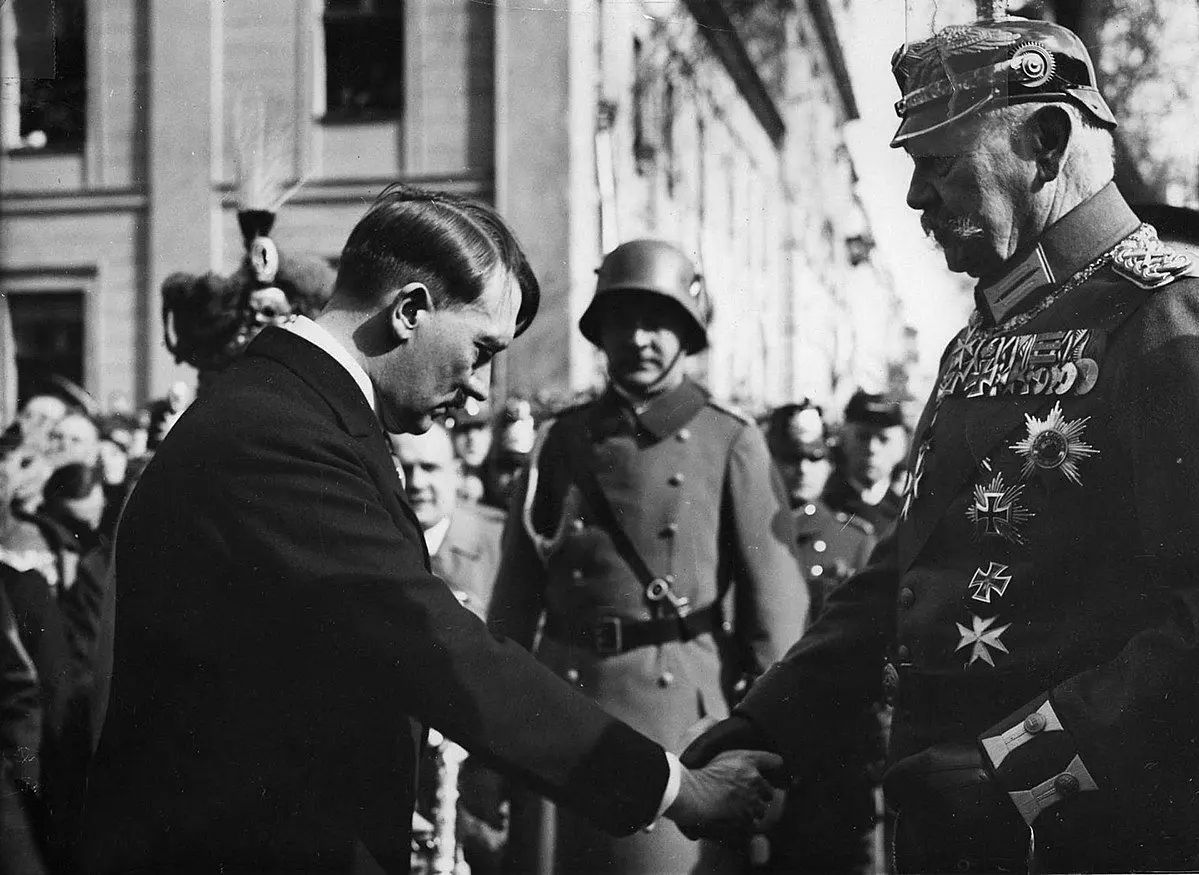
On 30 January 1933, the President of the Reich Paul von Hindenburg appointed Adolf Hitler as Chancellor of the Reich. This act created the formal basis for the establishment of an open fascist dictatorship in Germany. However, this specific form of bourgeois rule had already been prepared and developed as an option in the 1920s as a reaction to the „humiliation of Versailles“1 and as a necessary prerequisite for revenge, i.e. for the next great war. Moreover, fascism was the most effective weapon against a strong labour movement that challenged the power of the German monopoly owners in Germany and, on an international level with the Soviet Union, world capitalism and imperialism.2
From 1924 onwards, German imperialism achieved a phase of relative stabilisation. This was characterised by a massive concentration of production and capital. Important monopolies emerged and developed, such as IG Farben in the chemical industry and Siemens in the electrical industry. This was accompanied by a wave of rationalisation and modernisation in production facilities, which meant intensified exploitation and impoverishment. For capital, between 1924 and 1929, this led to a 25-fold increase in labour productivity in monopoly enterprises.
Due to their economic power, the monopolies had a significant influence on the politics of the Weimar Republic. The strengthening of German capital was also supported and enabled by the USA, which regarded German imperialism as an important pillar in the fight against the Soviet Union. The Dawes Plan alone brought more than 800 million gold marks in bonds into the Weimar Republic. In return, the USA secured partial control over the Reichsbank, the Reichsbahn and part of the state budget. This restricted the sovereignty of the Weimar Republic and at the same time strengthened German imperialism. Even during this phase of relative stabilisation, parts of German industry began to deliberately promote the National Socialist German Workers‘ Party (NSDAP), as they saw it as the political force that most consistently represented the class position of German capital, was capable of crushing the revolutionary workers‘ movement through terror, and was pushing to make Germany ready for war again. By this time, it had long been clear to the German monopoly bosses that they would make a second attempt at world domination. It was also clear that an adversary was developing in the form of the Soviet Union in the East, which threatened the power of the monopoly bourgeoisie throughout Europe. The fascists presented themselves as uncompromising fighters against Bolshevism.
The global economic crisis of 1929 and its consequences
The class struggle came to a head with the global economic crisis of 1929. This crisis dominated the entire capitalist world. Industrial production slumped by up to 50% and agricultural production fell by 30%. World trade turnover fell by a third and Germany’s share of world industrial production declined from 15% to 9%. The consequences were mass unemployment and the impoverishment of workers and peasants on the one hand, and centralisation and state support for monopolies on the other.
Against the backdrop of the crisis, fascism became a concrete option in several countries. More and more sections of capital hoped that, with the help of open dictatorship, profits could be increased again in various ways. Italian fascism, led by Benito Mussolini since 1922, provided an important point of reference in this regard. In the Weimar Republic, this development was expressed politically in the undermining of bourgeois democracy by presidential cabinets and emergency decrees. But the fascists also expanded their power on the streets: the NSDAP, and the paramilitary organisations Sturmabteilung (SA) and Schutzstaffel (SS), enjoyed popularity at this time and were able to grow significantly. Supported and financed by industry and with ever-increasing backing from the petty bourgeoisie, but also from sections of the declassed proletariat, they built up their terror against the communists and the labour movement years before the transfer of power. The fascists were unable to gain a mass base in the working class – they recruited mainly from the petty bourgeoisie, the intelligentsia and civil servants, as well as other intermediate strata.
The labour movement between conformity, revolutionary upheaval and anti-fascist struggle
The labour movement itself was confronted with major internal and external problems. Reactionary forces used the stab-in-the-back myth3 and other anti-communist propaganda against it. In addition, the defeat in the November Revolution of 1918 continued to have an impact. At the same time, reformist ideas about changing the Weimar Republic were widespread in the labour movement, including ideas about „democratising the economy“ and „organised capitalism“.
At the same time, however, the Communist Party of Germany (KPD) developed into a revolutionary party with roots in the masses, which, under the leadership of Ernst Thälmann, drew important conclusions from the November Revolution. This meant transforming the KPD into a powerful, organised party modelled on the Bolsheviks, thus building the structures that had been lacking in the November Revolution. The KPD played a leading role in the great struggles of the 1930s, such as the Mansfeld miners‘ strike in 1930, the Ruhr miners‘ strike in 1931 and the Berlin transport workers‘ strike in 1932. In these struggles, it relied on an organised mass movement against the shifting of the burden of the crisis onto the working class, against the fascist movement and against the policy of emergency decrees. Ideologically, the KPD underpinned this with several programmatic declarations at the beginning of the 1930s. In its “Programme Declaration for the National and Social Liberation of the German People” of August 1930, the KPD exposed the class character of fascism, named monopoly capital and the large landowners as the culprits of crisis, hardship and misery, and held up the Soviet Union as a model for the working class. With the Farmers‘ Aid Programme and the Job Creation Programme of 1931, the KPD developed concrete proposals for immediately improving the situation of workers and farmers and linked these to the struggle against fascism and arms production.
The formation of the organisation Antifaschistische Action by the KPD in 1932 marked the high point of activities against burgeoning fascism. The party thus pushed for the establishment of a broad united front against fascism and founded numerous united front committees in June/July, in which communists, social democrats and other anti-fascists jointly organised resistance against the increasing fascist terror. At the same time, in the Reichstag elections in July 1932 the NSDAP achieved its best result during the Weimar Republic, with 13.7 million votes. The effectiveness of the policies of Antifaschistische Action were seen in the results of the November 1932 election, in which two million voters turned away from the NSDAP. German monopoly capital, on the other hand, increasingly supported the NSDAP and paved the way for an open fascist dictatorship.
The open, terrorist dictatorship crushes the labour movement and leads the world into war
The NSDAP, SS and SA intensified their terror, and on 30 January 1933, von Hindenburg appointed Hitler as Chancellor of the Reich. The KPD responded with a call for a general strike, but the right-wing leaders of the trade unions and the SPD rejected it. As a result, the strike did not take place. Illusions in the class character of the state and fascism, as well as an underestimation of the dangers posed by them, led the SPD to continue to see the KPD as the greater threat, thus allowing what was probably the last chance to prevent the fascist dictatorship to slip away. As early as February 1933, the fascists staged the Reichstag fire and used it as a pretext for an unprecedented witch hunt against members of the KPD and other political opponents. The establishment of the „Secret State Police“ (Gestapo) and the „freedom to shoot“ for the police and the „auxiliary police“ composed of the SA and SS were further important milestones in the establishment of open dictatorship. The Reichstag elections in March 1933 were nothing more than a farce. Nevertheless, more than 4.85 million people voted for the KPD, which was already effectively illegal. This meant that the NSDAP, as it did not even achieve a simple majority, was far from the two-thirds majority it needed to repeal the Weimar Constitution. For this reason, it declared the KPD’s mandates invalid and further secured its power with the Enabling Act of 23 March 1933.
Fascism in power ultimately led to the destruction of the labour movement, the trade unions and their most politically consistent party, the KPD. Even the SPD could not escape this fate for long. Ideologically, fascism prepared the German working class for the planned war of plunder and aggression. The economy was also geared towards preparing for this war, and German monopoly corporations achieved record profits in their preparations for a further attempt to establish German imperialist hegemony in Europe and to destroy the Soviet Union. Ultimately, fascism plunged the people into the Second World War, which was planned from the outset as a war of annihilation against the Soviet Union.
This war also involved the establishment of fascist organisations and their use against the Soviet Union in the conquered and conquerable territories, in the liquidation of communists, pogroms against Jews, etc. In some countries, these collaborators were an important element of German fascism and its war. Stepan Bandera’s „Ukrainian Insurgent Army“ (UPA) was a brutal terrorist organisation that murdered hundreds of thousands of Poles, Jews, Roma and Russians, as well as Ukrainian communists. Reference to them is now part of the state doctrine of the Kiev regime, and their leaders are celebrated as national heroes.
Fascism lived on in the Federal Republic of Germany
The open dictatorship of capital in Germany lasted twelve years before the Allies, led by the Soviet Union, defeated fascism militarily. This military defeat was tantamount to breaking the power of the monopolies in those parts of Europe that were liberated by the Red Army and the communist-led partisan groups. The subsequent development of the people’s democratic and socialist states were shaped by a fundamental anti-fascist and anti-imperialist understanding. Countless monuments were erected in the German Democratic Republic (East Germany) and the Soviet Union to commemorate the heroic and costly struggle of the Soviet people, and these monuments are still visible today.
In the West, however, anti-communism and hatred of Russians remained a matter of state policy. In the courts, in the military, in the parties, parliaments and on the government benches, in schools and government agencies – nowhere in the Federal Republic of Germany (West Germany) did serious denazification take place. The power of the monopolies and their profits from fascism and imperialist wars of aggression remained untouched, old Nazis returned to office and positions of honour, and the FRG was quickly rebuilt as a frontline state against socialism. In its new tasks, monopoly capital could not do without the fascists; after all, they were useful and experienced in combat, especially in the fight against communists and socialism in the East.
With the counter-revolution of 1989-91 in the GDR and the Soviet Union, the achievements of socialism were finally eliminated. The GDR was annexed and incorporated into the resurgent imperialist FRG; the Soviet Union was smashed. The return of monopoly power in the countries where socialism had prevailed was directly linked to the spread of fascist structures, in addition to the devastating social consequences for the working class. In Germany, the self-exposure of the neo-Nazi National Socialist Underground (NSU) eleven years ago made it clear how closely the bourgeois state is actually entangled with fascist structures. Since then, hardly a month has passed without right-wing activities in the police, military, security agencies, judiciary or administration coming to light.
German imperialism has in fact always kept fascism as an option and promoted its structures. But it has not only done so in Germany; it has also promoted it abroad, for example in Ukraine. During the time of the Soviet Union, it was not easy for the imperialist states to support fascist structures in socialist countries. However, fascist terrorist groups raged underground and murdered tens of thousands of people even after 1945, such as the Ukrainian Insurgent Army (UPA), covertly supported and financed by the CIA and the German Federal Intelligence Service (BND).
Fascism in Ukraine since 2014
With the 1989-91 counter-revolution, open support for fascist forces became increasingly possible. From the outset, NATO has referred positively to Nazi collaborators in the context of its eastward expansion and has attempted to rehabilitate them, for example in Croatia, Kosovo – and indeed in Ukraine. Fascists trained with weapons and prepared themselves in these countries in the 1990s. The coup d’état associated with the Maidan coup and the brutal war against Donbass were made possible by the actions of fascist forces. Excessive violence and terror were directed against communists and other political opponents, as well as Russians, among others. They have now established themselves in Ukrainian security agencies and occupy important key positions.
The war unleashed in 2014 against the People’s Republics in Donbass and their resistant population was characterised by fascist forces from the outset and served NATO’s purpose of preparing for war against Russia. In 2014, public attention was focused in particular on the fire and murders in the trade union building in Odessa, the fatal shooting by Azov supporters at a 9 May rally in Mariupol, and the murder of two anti-Maidan activists in Kharkiv. The leadership ranks of the coup state included fascists who used their terrorist structures against the anti-fascist movement. The Ukrainian government’s so-called „anti-terrorist operation“ primarily used these structures to brutally combat the autonomy efforts in eastern and southern Ukraine. The massacres in Odessa and Mariupol were punitive expeditions by the Kiev regime against the growing opposition. Little attention was paid to the deliberate establishment of so-called „city guards“ in several cities, which often consist largely or entirely of fascists. For example, the „city guard“ in Kiev was mainly composed of members of the fascist organisation „C14“, founded in 2010, which is responsible for several political murders and pogroms against Roma. These right-wing forces are financed by leading figures from politics and business, such as Rinar Akhmetov and Igor Kolomoisky, who also supports Azov and the Right Sector, among others. Fascists have also been deliberately installed in the Ukrainian secret service, where they now spread terror on official orders.
Racism against Russians and anti-communism have increased significantly in the country since 2014. This development is accompanied by official bans and repression against communists and Russians. The Communist Party of Ukraine was effectively banned in 2015, the publication of communist symbols is punishable by five years in prison, state censorship closed critical media outlets, and according to the Attorney General’s Office, more than 30,000 people are currently being prosecuted for „political crimes“. The number of people affected is likely to increase significantly in view of increasingly stringent laws, such as the one „against the justification of the aggression of the Russian Federation“. Right-wing extremist forces are integrated into the state and repressive apparatus, and legislation is being enacted that prohibits the use of the Russian language. At the same time, Ukraine is developing into a military training camp for fascists from all over the world, as their structures can operate openly in Ukraine and are even supported by the state.
The fascists in Ukraine are needed to wage war against Russia. That is why the US, NATO, Germany and the EU supported the Maidan coup and helped to establish the necessary structures. For this reason, the then Foreign Minister and current Federal President Steinmeier (SPD) appeared publicly with fascists in Kiev as early as 2014. With „Slava Ukrajini,“ a fascist salute can once again be heard in the Reichstag. Fascism in Ukraine is gaining influence and is being deliberately promoted – by those in power in Kiev, Washington and Berlin.
Against this backdrop, it is not surprising that 90 years after the transfer of power to the German fascists, monuments throughout Europe commemorating the Soviet Union’s Great Patriotic War of 1941-1945, which marked the end of fascism in power in Germany, are being demolished. The memory of the anti-fascist struggle is being destroyed and criminalised.
Imperialism and fascism go hand in hand
The manifestation of imperialism and fascism may have changed, but in essence fascism remains the most aggressive form of bourgeois rule. And the means at its disposal remain similar. For the working class, fascism means terror, oppression and intensified exploitation, accompanied by the destruction of the structures of the labour movement. In this respect, neither the deliberate build-up of German fascists in the 1920s nor the support of Ukrainian fascists by the Federal Republic of Germany are mere accidents of history. They are an expression of the class character of fascism and the relative crisis of imperialism.
As long as imperialism prevails, fascism will remain alive. At a time when Germany is once again waging war against Russia in Ukraine, the direction of the struggle must be clear for communists:
Against fascism in Germany and Ukraine, against anti-Russian agitation and racism!
No to war means no to NATO!
For the defeat of German imperialism!
For the defeat of German imperialism!
- After the German Empire lost the First World War, which it had started itself, the Treaty of Versailles dictated peace terms that, in addition to large territorial losses (Germany lost its colonies and large areas on its eastern and western borders in Europe), were also intended to prevent the development of (heavy) industry and the military. In addition, there were high reparations payments. These conditions favoured the development of revanchism and fascism. ↩︎
- Even though the November Revolution of 1918 failed in Germany, it gave rise to the KPD, a communist party that, in addition to electoral successes, also had a strong mass base and thus seriously threatened the rule of capital in Germany. ↩︎
- The stab-in-the-back myth claims that it was the November Revolution that was responsible for Germany’s defeat in the First World War. According to this myth, the protests of the workers and soldiers stabbed the Supreme Army Command in the back, making it impossible to win the war. This, it was claimed, led to the German people becoming dependent on the victorious powers and losing their sovereignty. Yet it was precisely the revolutionary uprisings in Russia and Germany that ended the suffering of the workers caused by the imperialist war and gave the working class a vision for a better future. ↩︎