


A plan to weaken Russia
The “Trump-Ukraine Plan,” its significance for Russia, and the reaction of the peace and communist movements
In this text, we want to evaluate the “Trump Plan” and, in particular, the psychological warfare associated with it and show why the equidistant stance of many leftists and communists, as well as the pacifist stance of the peace movement, is a problem and why a process of clarification is necessary in practical terms.
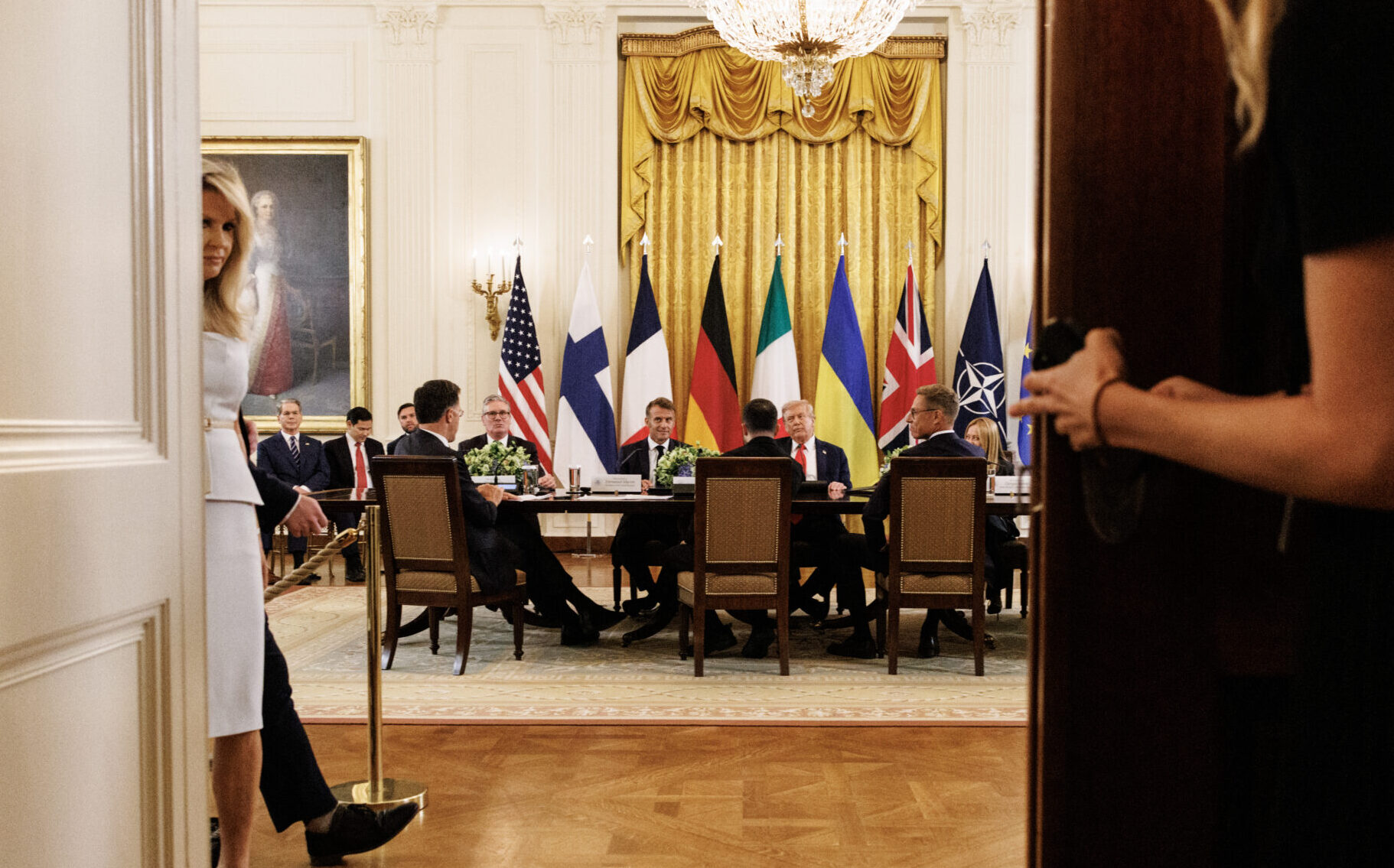
The latest “negotiations” between the EU, Ukraine, and the US on the “plan” are not yet complete, but it is becoming apparent that “multinational” (i.e., NATO) troops are planned for Ukraine. The Ukrainian armed forces are to be increased from 600,000 to 800,000 troops, and Russia’s foreign assets are to be confiscated for “reconstruction” to the tune of over $200 billion (which corresponds to about one-third of Russia’s GDP). Furthermore, Tomahawk and Taurus missiles are to be stationed throughout Ukraine. This is an undisguised announcement of the continuation and escalation of Western aggression.
The contrast between Western propaganda on the original “28-point plan” on the one hand and the perception in Russia on the other could hardly be greater. The media and politicians in Germany claim that the “plan” was in Russia’s favor and “dictated by Putin.” This contradicts the assessment of most analysts in Russia, who emphasize that the agreement would be very bad for Russia. Russia’s war aims would not be achieved and, as a result, a very large Ukrainian army (600,000 troops) would be stationed directly on the border, with full NATO support and integration, thus continuing to pose an existential threat to the Russian Federation.
The regime in Kiev, which is completely dependent on the West, would remain a fascist regime that persecutes anti-fascists and has already demonstrated its brutality in the war against the Russian-speaking parts of the population. The threat to the Russian population in Ukraine is an important reality, but one that is not recognized in Germany and is dismissed as propaganda lies.
Putting pressure on compradors
The “Trump plan” was never a real option but served to deliberately exacerbate the corrosive contradictions within Russia’s political front. The forces of the comprador bourgeoisie that are committed to collaboration with the West are to be deliberately pressured and enticed.
The “plan” is linked to the simultaneous tightening of sanctions. Among others, these are directed in particular towards Rosneft, the oil company that is important for the economy as a whole, but which is also behaving very opportunistically and is therefore being deliberately pressured by the US in order to build up pressure against the patriotic forces.
The “Trump Plan” is therefore part of the West’s warfare: precisely at the level of war psychology. It is the continuation of war by other means, just as war is the continuation of politics by other means. Russia launched the military operation for specific reasons that have not yet been fulfilled, but which are considered to be of central importance for the Russian Federation (and beyond). To this day, these political goals are largely unrecognized by the Western left—and thus the fight against NATO and fascism is not considered vital for Russia’s survival.
Prerequisites for defending the country
The Communist Party of Russian Federation rightly points out that Russia’s reintegration into the Western club is a means of weakening Russia. Instead, a policy of sovereignty and rapprochement with BRICS and China is needed.
The party emphasizes that, given the military situation, there is no need for a deal as it would rather be a compromise with those who have not given up their hostility and are acting not in the interests of the population but in the interests of big capital.
According to the CPRF, the expropriation of capital in Russia and the establishment of socialism in one country are necessary prerequisites for the proper defense of the country against imperialist aggression. In this, they agree with other communist forces. The CPRF considers the liberation of the remaining parts of Ukraine, where mainly Russian populations live, to be necessary and stresses on the overall political significance of the war aims.
Consistency and inadequacy of state leadership
So far, the Russian state leadership does not seem to be responding to the bogus offers and is sticking to the necessity of military action. It remains to be seen to what extent pressure from the West will lead to changes in the future. Despite the state leadership’s initially consistent continuation of its course, there are points that should be briefly addressed.
The government has failed to mobilize broad patriotic support for the war and has done little to explain its war aims. At the same time, there is a tendency to downplay the “special operation” as a “tragedy” and no attempt to explain that Russia is resisting imperialist aggression. There is insufficient explanation as to why NATO is waging war against Russia. There are great illusions, fueled by the media, that with a different, “more Russia-friendly,” “conservative,” “more rational” policy, the Western states would come to their senses again. Accordingly, many people there hope for “peace.”
The Russian leadership’s rejection of the deal will be met with dissatisfaction internationally, but also in Russia, partly because the economic situation is deteriorating due to the pressure of sanctions. However, this pressure can only have an effect because the economy is partly controlled by collaborators.
These weaknesses and political inconsistency can lead to a weakening of political insight into the necessity of defending the country and is therefore directly relevant to war. Imperialism is fully aware of the importance of war psychology and morale, and uses this as a weapon.
The contradictions between the US and the EU and the alliance between Russia and China
The Trump plan has also revealed contradictions between the US and the EU, although it is not yet possible to assess which of these are serious contradictions and which are merely tactical. The US is preparing for a major war against China. This requires splitting the alliance between Russia and China, which is the aim of this deal and the sanctions. It remains to be seen to what extent Germany and the other EU states will take over the responsibility of carrying out the war against Russia so that the US can concentrate fully on China.
The economic separation of Russia and the EU is part of the US strategy, as was particularly evident in the destruction of the Nord Stream pipelines. The US aims to subjugate Russia and bring it under its own control, thereby weakening Germany’s position.
The inter-imperialist contradiction between the United States and the European Union, and especially with Germany as the leading power in the EU, should not be underestimated. How exactly this contradiction plays out and what impact it has on the common front against Russia and China needs to be analyzed more closely.
In any case, the maneuver of the “Trump plan” for Ukraine also aims to drive a wedge between Russia and China, ensuring increased aggression against China and facilitating blackmail. Politically, this plan is unlikely to succeed, but the economic sanctions weigh heavily and reveal the vulnerability of Russia and China and the danger posed by the weapons in the arsenal of the US and the EU.
The German peace movement and its “negotiate at any price” approach
Many commentators, including those from the peace movement, welcome the “Trump plan” in principle as a means of ending the war. Negotiations must take place at any price. This disregards the political issues and ignores the reasons why the Russian Federation launched its military operation. Furthermore, it assumes that the West is serious about “negotiating,” ignoring, among other things, that all previous agreements (Minsk I and II) have only been used to enable the Ukrainian army to fight against Russia.
In particular, the diversionary tactics of the Trump administration, which masquerades as “pro-Russian,” are partly accepted, thereby strengthening NATO’s war psychology. For Trump and the EU, the sole aim of these maneuvers is to gain time, rearm and strengthen their forces, and then strike even more aggressively against Russia and China.
The “equidistance” position of parts of the communist movement
Large sections of the communist movement continue to advocate equidistance and an anti-Russia position. They will interpret the plan as confirmation that the great powers are dividing up Ukraine; that the Russian bourgeoisie and “its government,” i.e., “Russia,” allegedly wanted this war for territory, resources, and the Ukrainian market. There will also be an interpretation that Russia’s bourgeoisie has used this war to enter imperialist competition with a new, strengthened position.
However, the opposite is true: the “plan” is part of NATO’s aggression and serves to undermine Russia’s political goals. It is thus part of its subjugation. Russia’s capital is partly collaborating with this strategy of subjugation and would prefer to strike a deal today rather than tomorrow—with all the political consequences that entails, including the continued existence of the fascist regime in Kiev and its rearmament.
“Russia,” i.e., the people, the state, and capital, are not the same thing—anyone who says so does not understand the class relations in this country in relation to international finance capital. The Putin government is not a reliable force either, but so far it has shown a certain consistency and also rejects the “plan.”
A case for the clarification process
As Kommunistische Organisation (KO), we have learned that intensive debate and engagement on key issues is absolutely essential. We have conducted a debate within the organization and publicly that has brought to light the essential features of the opportunistic stance of equidistance (see, among others, I, II, III, IV). Spurred by the urge to understand why the Russian Federation acted as it did, how imperialism is structured, and what this means for the working class, we worked in study groups and published theses on the war in Ukraine, in which we emphasized that Russia is resisting imperialism in Ukraine. In our view, these steps have proven valuable and useful in better understanding further developments. This does not mean that the concrete analysis of the concrete situation and its development is complete.
In the international communist movement, the assessment of the war and imperialism remains highly controversial, with little real debate taking place. Developments surrounding the “Trump plan” show why a process of clarification and intensive debate within the communist movement is urgently needed! Not only because misconceptions exist, but because with each new development, confusion, distraction, and false hopes (for a negotiated peace by the aggressor NATO) or false schemata (“all imperialists”) increase.
If there is no clarity about the political goals of the Russian Federation, its position in relation to imperialism, and the need to defend national sovereignty for the working class, pacifist and opportunistic (equidistant) positions can gain ground. This is accompanied by a depoliticization of the discussion, which no longer seriously addresses political issues that are of great importance to the peoples of Eastern Europe and Western Asia.