

An important step in the Communist movement – but is it enough?
Report from the Third International Anti-Fascist Forum in Moscow
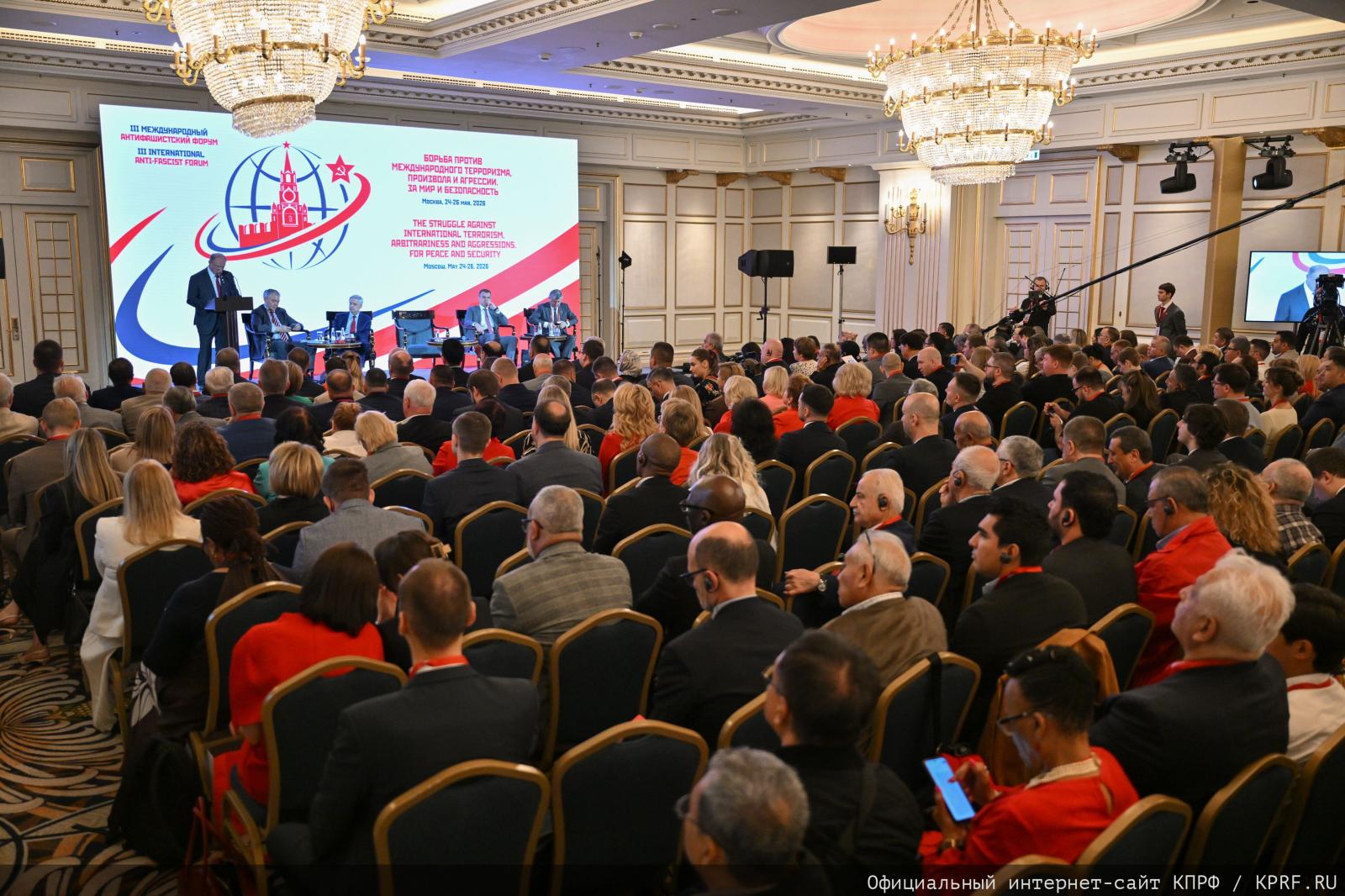
We report from the Third International Anti-Fascist Forum in Moscow, an important international exchange within the Communist movement. In the second part, we summarize key points from individual speeches.
Here you’ll find a selection of speeches delivered at the forum (in German).
On the night of May 21-22, the army of the Kyiv regime attacked a student dormitory in Starobilsk, near Luhansk. They killed 21 young people and injured another 40. Deadly violence against anti-fascists was already perpetrated in Ukraine in 2014. For over two and a half years, the West has been supporting the genocide in Gaza in full view of the world. It is becoming clear that the use of terrorist violence against civilians is now considered a normalized means of achieving the West’s political goals. The situation is serious; imperialism is escalating its aggression. This was also clearly evident in the atmosphere at the Third International Anti-Fascist Forum in Moscow.
The International Anti-Fascist Forum, convened in Moscow from May 24th to 26th by the Communist Party of the Russian Federation, was dedicated to the „fight against international terrorism, arbitrariness, and aggression – for peace and security.“ Over 180 delegations from nearly 100 countries gathered to discuss, exchange information, and coordinate the common struggle against imperialism and fascism.
For us, participation was very interesting and productive. Our project for a clarification process within the International Communist Movement, as well as the course on the history of communism, generated interest in the discussions. The Antifascist Forum has become a, perhaps the, central forum for exchange within the Communist Movement and has produced a wealth of content. From our perspective, however, more intensive and theoretical forms of exchange are needed. The question also arises as to how a stronger shared focus and direction for the struggle can be achieved so that forums for exchange lead to more than just declarations.
Split in the International Communist Movement
The forum was the third assembly of its kind. It represents a new and important development within the Communist movement, aimed at uniting forces in the struggle against imperialism and fascism. It is also a reaction to developments within the Solidnet network, which has failed to organize a debate to overcome the movement’s deep-seated disagreements. The sharp break with the KKE and its affiliated parties has accelerated this process. This substantive division is evident in numerous documents and has further paralyzed the Solidnet network.
The Communist Party of the Russian Federation (KPRF) did not organize or frame the forums as a counter-project, but recently extended renewed offers of discussion to the Communist Party of China (KKE). These were rejected . Nevertheless, bringing together forces that agree Russia and China are waging a common struggle against imperialism and fascism is important.
The conference offered an important opportunity for networking and exchange within the communist movement. As the largest communist party in the post-Soviet space, the Communist Party of the Russian Federation (KPRF) serves as a crucial point of reference and was able to fulfill this purpose through the conference. Within the Russian Federation, it represents a central force supporting the struggle of the People’s Republics. Globally, it facilitates cooperation among progressive anti-imperialist forces.
Important forum with forces from the Global South
The gathering of so many parties was also interesting because their respective fighting conditions are very different. The most important message of the speeches and the atmosphere was that all forces must unite to fight against the aggression of NATO, imperialism, and its fascist instruments. This is also addressed in the declaration of Conference 2 .
Shaped by this situation and atmosphere, parties primarily from the Global South, countries threatened or attacked by imperialism, came together. The presence and efforts of the Communist Parties of the Russian Federation, Belarus, the People’s Republic of China, the DPRK, Cuba, and South Africa, as large and in some cases ruling parties, played a central role. But smaller opposition and suppressed parties also played an important part. It is worth noting that the Chinese Communist Party was very prominently present—a change from its previously more reserved role. The contributions of the Belarusian Communist Party are particularly interesting, as they strongly emphasize the ideological questions of the movement and focus on building a new Communist International.
New dynamics in Europe too?
The European movement was represented by only a few large parties, including the PCP from Portugal. Parties from Great Britain, France, Germany, Italy, Hungary, Spain, Finland, Switzerland, Poland, Romania, and other countries were represented. Many interesting discussions took place, some concerning how to overcome the movement’s crisis. It was also important to learn that some parties, such as those in Hungary and Romania, had conducted analyses of their 1990 defeat and their party history.
There are numerous new political parties being founded or existing structures being rebuilt across Europe. The dynamics are particularly strong in Italy. Fueled by protest movements and dissatisfaction with the status quo, four parties have emerged with nationwide structures and are increasing their presence. We intend to study their policies and strategic considerations and engage in dialogue with them. The efforts of the PRCF in France are also of great interest to us.
In light of the dangerous escalation of the situation by NATO fascism, our impression was that the efforts were still insufficient. Particularly in Europe, much needs to be done to achieve greater collective strength. In this context, we consider the organization of a systematic clarification process to be an important instrument for identifying and resolving problems.
Analyses of Fascism and Imperialism at the Forum
Final statement outlining strengths and weaknesses
The forum’s final declaration emphasizes the necessary fight against fascism, stating: „We stress that our fight against neo-Nazism and terrorism is fundamental in nature. There is no room for compromise in it. It is directed against forces that aim to revise the results of the Second World War, rehabilitate the accomplices of Hitler fascism, and erase the memory of the heroic deeds of the anti-fascists.“ Fascism is defined as „not an accidental detour in world history,“ but as a result of the crisis of capitalism, „born of big capital’s fear of the working people, of its desire to enslave and oppress them.“ Fascism is described as the ambition of the financial oligarchy, which seeks to maintain its power at any cost.
Terror and terrorism are particularly emphasized, their breeding ground being social inequality, lawlessness, and poverty, as well as interventions and genocide, the imposition of neocolonial practices, arbitrary sanctions, and cynical blockades. The people do not possess the colossal masses of wealth; rather, the masters of banks and financial groups do. All the causes of terrorism must be eliminated. The Russian Federation’s special operation in Ukraine is placed in this context, with the participants emphasizing their support for Russia’s anti-fascist and anti-terrorist activities within this framework: „We consider this struggle part of the general resistance against global dictatorship, state terror, militarism, and neo-Nazism. We strongly condemn the attempts to use Ukrainian territory as a springboard for the expansion of imperialist influence.“
The descriptions of other theaters of the struggle against imperialism are rather general and, in some cases, not sufficiently clear (West Asia, Palestine, Iran) or are omitted altogether, as is the case with the struggles in Africa. The descriptions of terrorism are imprecise insofar as it is not always clear which forces are meant by which description. The characterization of imperialist methods as terrorist is entirely correct and is particularly evident in Ukraine. The term „state terror“ is only used in relation to Cuba, but not in relation to the crimes of the Zionist entity, even though genocide is explicitly named. Zionism as an important form of fascism, however, is not mentioned. Other important sources of the anti-imperialist struggle are missing; this also applies, and perhaps especially so, to the struggles on the African continent. The experiences of the Democratic People’s Republic of Korea are also not mentioned. In a certain sense, this reveals a weakness of the movement, namely that the various theaters of struggle and forces against imperialism have not yet been unified. This is a task that confronts all communist forces.
Continuity of violence by the West
The forum began with a short film and a longer address by Gennady Zyuganov, General Secretary of the Communist Party of the Russian Federation (CPRF). The first task was to place the current escalations of imperialist violence within the historical development of capitalism. Zyuganov explained that until the 17th century, Europe could by no means be considered the „locomotive of progress“ and was inferior to the Asian empires in many respects. The violently established dominance of Western states through the exploitation of the rest of the world ultimately formed the basis for the rise of fascism. Regarding German fascism, he emphasized Hitler’s orientation towards Anglo-Saxon systems. Furthermore, after the Second World War, large segments of the fascist movement continued to be integrated into the Western system. This process is now continuing in Ukraine as well. In light of the escalation of imperialist violence, Zyuganov emphasized that it is the task of communists to provide education and to shed light on the background of the crisis and violence, contrary to the propaganda spread by the ruling classes.
Building an anti-imperialist front
In his address, Sergei Syrankov, General Secretary of the Communist Party of Belarus, defined the monopoly on the use of high technology and the associated possibilities for concealing and legitimizing violence as central components of imperialist terror. He also emphasized the concentration of global wealth since the 1990s and access to cutting-edge technologies in the hands of a global oligarchy. He concluded his speech with an appeal for the establishment of a new Communist International, alongside a front of progressive and patriotic forces. Other speakers, such as the Cuban Ambassador to the Russian Federation, Enrique Orta González, stressed the distortion of terms when, among other things, his homeland, which has historically been the victim of numerous terrorist attacks by the USA, is declared a „terrorist state“ by the very same nation.
Fascism as the normal state of imperialism
Discussions about the continuity of imperialist violence since the Cold War also enriched the debate surrounding the current escalation of imperialist violence. In her presentation, Indian political scientist Radhika Desai described the Cold War-era „false image“ of fascism as an unusual form of bourgeois rule. Rather, the supposed compatibility of democracy and capitalism in Western states was an exceptional circumstance of the Cold War, which has been dismantled over decades through various phases of liberalization reforms and fascist erosion. In international politics, however, the USA has always considered the disregard of international law a legitimate means. The representative of the Communist Party of Brazil (PCdoB) emphasized, among other things, the close connection between fascism in his homeland and global imperialism. He presented the establishment of the military dictatorship in 1964 as a prime example of fascism’s function in achieving economic goals.
The leading role of the CPRF in the fight against imperialism
International efforts to build a multipolar world order were highlighted at the forum primarily as positive steps against imperialism. Russian President Vladimir Putin also emphasized these ongoing efforts in his welcoming address to the forum. Zyuganov had previously stressed the positive role of the People’s Republic of China in creating new institutions for international cooperation. Within the Russian Federation, he presented the Communist Party of the Russian Federation (CPRF) as the force that would most decisively wage the struggle against imperialism.
Achievements of socialism as a strength
Syrankov also emphasized the Belarusian government’s pioneering role in shaping the BRICS into an organization capable of significantly weakening dollar-based financial hegemony. Regarding the country’s resilience against external attacks, he highlighted the development of Belarusian industry, built upon the solid achievements of socialism under Lukashenko’s government. Viktor Tyulkin, Chairman of the Russian Communist Labour Party, also stated that while communists should support the efforts of Russia and China, they must remain mindful of their duty to lead the conscious struggle against fascism. A representative from the Donbas described his homeland as „the Spain of our time“ and emphasized the international composition of anti-fascist fighting forces that effectively combat fascism there. Leonid Razvoszhayev, representative of the Levy Front, also stressed the need to support the Russian government in its fight against the West, even though he himself had been imprisoned by it. He described the elimination of the Western labor aristocracy as the most fundamental goal of our time.
The conflict in West Asia
A spokesperson for the Jordanian Communist Party also characterized West Asia as the center of imperialist aggression and crisis. The representative of the Palestinian Communist Party, in his speech, declared the necessity of combating Zionism as one of the most significant current manifestations of fascism. Given its current importance, this aspect was somewhat underrepresented at the forum. Furthermore, the Greek representative of the World Anti-Imperialist Platform, Dimitrios Patelis, emphasized the historical significance of the Islamic Republic of Iran’s struggle against Western hegemony in West Asia.
Fight against historical revisionism
Combating historical revisionism and preserving the memory of the Second World War was also declared a central task of the Communists by various representatives. Gyula Thürmer, chairman of the Hungarian Workers‘ Party, spoke of the Communists‘ duty to defeat the „fascism of the past“ „again and again.“ The representative of the Communist Party of Bulgaria emphasized the reign of terror under the monarcho-fascist regime, which interned one million Bulgarians in concentration camps. It remains important to remember that the names of the liberators of Berlin, inscribed on the Reichstag building, are largely Russian.
International exchange is necessary
The need for increased exchange within the global communist movement was also raised. While Tjulkin supported the idea of a conference in Havana in September where various communist parties would meet to discuss the Cuban question, he simultaneously emphasized the need to discuss the blockade of Cuba as part of the escalation of imperialism.
The question of Islamic forces
It is also necessary to give greater consideration to the fact that other progressive forces, including progressive Islamic forces, play an important role, particularly with regard to the national question. While there may have been a consensus at the conference on the role of the Russian Federation in the war in Ukraine, there is certainly a need for further clarification regarding the assessment and historical evaluation of Islamic forces. The fact that the West has cultivated forces calling themselves Islamic as terrorist groups, which have perpetrated serious terrorist attacks with high casualty figures, not least in Russia, likely played a role. A comprehensive analysis would naturally have to include these phenomena. However, this analysis should also consider the role of the Palestinian resistance and the Islamic Republic of Iran as important forces in the anti-imperialist struggle, and their experiences, as instructive examples.
Problems and weaknesses – but also organized exchange
The conference also had weaknesses, reflecting problems within the movement, perhaps especially in the imperialist countries. The relevant political issues were often not addressed as such. The political problems of the Communist movement should be overcome through a political and self-critical process. Such a process requires considerable effort, including theoretical work. It is possible that the forum was not intended for such work at all, but rather aimed to provide orientation for those forces that already agreed on important fundamental issues.
Learn more and exchange ideas!
Learning from the experiences of parties in the Global South that have fought or are fighting hard battles is crucial for such a process. Conferences of this size may always have the character of many speeches strung together. This can be tiring and repetitive, but it also provides an overview of the positions and ideas presented. In Moscow, the exchange was framed by highlighted contributions and a summary of the speeches in both sessions. This at least allowed for a certain degree of synthesis and analysis.
Nevertheless, more intensive forms of engagement with a stronger focus on the core political and theoretical questions of the International Communist Movement would be important: What is the relationship between the struggle for socialism and the struggle for national independence? What role does the international working class play in this, and to what extent does its division between the imperialist centers on the one hand and the oppressed and colonized countries on the other play a role? What role do the BRICS play in this struggle, and what processes of anti-imperialist resistance are taking place in the imperialist centers and oppressed countries? How can communists succeed in connecting these struggles, and what theoretical and organizational prerequisites exist for this? What concrete experiences of struggle in the various countries can we draw upon—both today and from our forerunners? How have these experiences been and are they being processed theoretically? What role do the struggle for democracy and against fascism and historical revisionism play?
An exchange on these issues at an international level can be very productive, and we as KO would like to participate.
1 https://cprf.ru/2026/02/address-of-the-communist-parties-of-russia-to-the-communist-and-workers-parties/
2 https://www.unsere-zeit.de/fuer-gerechtigkeit-und-weltweite-entwicklung-ohne-faschismus-terrorismus-und-kriege-4815070/
3 https://www.youtube.com/watch?v=1rCHvmTbhqk&t=7298s from minute 13:53