


The battle for yesterday is the battle for today and tomorrow!
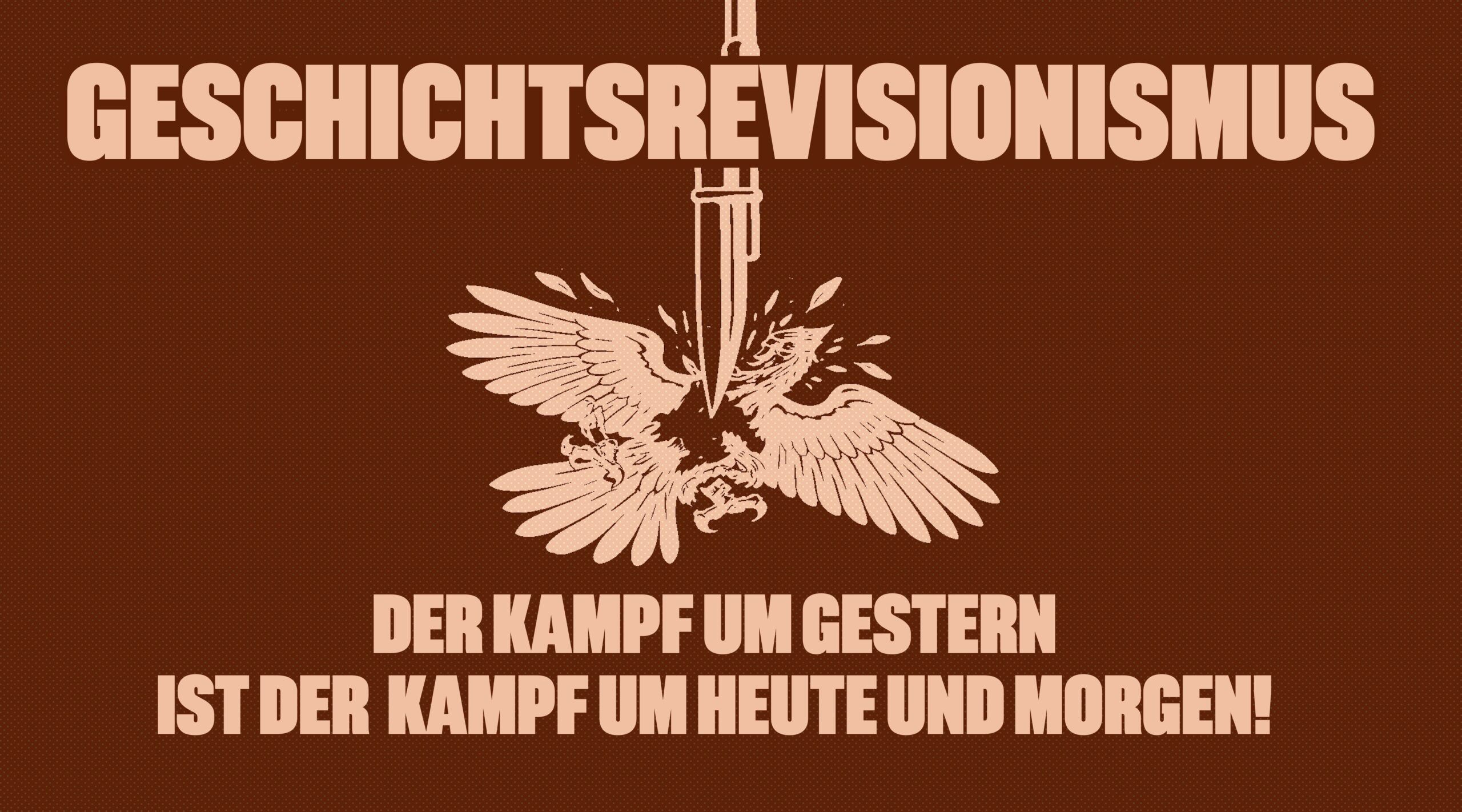
On the Federal Republic of Germany’s historical revisionism and why we must fight against it
Preparations for war are underway in Germany. The target is for Germany to be capable of waging war against Russia by 2029. To this end, the German war machine is being fuelled with 1.7 trillion euros, conscription is being prepared, and NATO’s war course is being supported. Germany’s past no longer stands in the way: through distortion, reinterpretation and lies, historical revisionism has succeeded in using the crimes of the past to legitimize new ones.
The so-called denazification of the FRG
To this day, the narrative is perpetuated that the FRG is a completely different state from its fascist predecessor and that a clear break with the fascist past has taken place. For this narrative, a few Nazi cadres had to lose their heads or their careers. The vast majority, however, who had supported and financed fascism, were able to move on undisturbed to build the new state of the FRG – whether their names were Heusinger, Gehlen, Globke or Krupp. Fascism as a political system was replaced by bourgeois democracy. The foundation of war and fascism, capitalism, remained untouched. And so, the FRG quickly became a bulwark of aggression – back then against the German Democratic Republic (GDR) and the Soviet Union, today against the Russian Federation. Fascism and war are not mere blips in German history; they are deeply embedded in this state, which throughout its history has repeatedly sought expansion, particularly towards the East.
Further reading → Der Faschismus als Rammbock des deutschen Monopolkapitals
The fairy tale of the ‘two German dictatorships’
What disrupted this narrative was the GDR. For it demonstrated what denazification actually looks like, and through socialist reconstruction, it undermined not only fascism but also the foundations of war. Whilst in the GDR former concentration camp inmates were building the new state, in the FRG their former guards and tormentors were back at work. After years of silence, FRG historians began to frame the Holocaust as a reaction to socialism, equating fascism with socialism. Today, the GDR’s anti-fascism is dismissed on the grounds that it merely served to legitimize its own “dictatorship”. Following this logic, neo-fascism in East Germany is also explained today: East Germans are said to have a “totalitarian inclination” due to their history. The fact that it was the FRG that built up neo-fascism in East Germany, both financially and in terms of personnel, is glossed over.
Further reading → Zur bürgerlichen Faschismustheorie und Neofaschismus in Ostdeutschland
8 May – End of the war instead of liberation?!
Whilst 8 May is celebrated in most countries around the world as a day of liberation from fascism, in Germany it is simply referred to as the ‘end of the war’. On the 80th anniversary, the German newspaper ‘Frankfurter Allgemeine Zeitung’ (FAZ) ran a headline stating that 8 May was no cause for celebration, whilst the radio station ‘Deutschlandfunk’ spoke of the ‘dark’ sides of liberation. Where there is no liberation, there can be no liberators: at official commemorative events, the role of the Soviet Union is downplayed; red and Soviet flags, as well as symbols or music of the Red Army, are banned; and representatives of the Russian Federation are consistently disinvited.
Further reading → Zum 80. Jahrestag der Befreiung
The relativization of German war guilt
For a long time, Germany’s preparations for war stood in the way of its responsibility for the Second World War. An instrument for relativizing war guilt was created by an EU resolution adopted in 2019, which summarized the practice already in place: it declared the German-Soviet Non-Aggression Pact to be a central factor in the Second World War and attributed partial blame to the Soviet Union for Germany’s war of annihilation. This not only denies that the Soviet Union fought fascism with the utmost vigor from the very beginning, but also attributes to it a share of the responsibility for its own destruction – German fascism left more than 27 million dead in the Soviet Union. At the same time, the responsibility of fascism is relativized and the historical guilt incurred by the Western powers through their long-standing support of German fascism is glossed over.
Tip for further reading → Broschüre „Geschichtsfälscher“
Zionism instead of anti-fascism
Through its support for Israel, the Federal Republic of Germany has cultivated an image of a reformed state, and German state policy has simply replaced anti-fascism with Zionism. The highly militarized occupying power of Israel is presented as the only possible consequence of Auschwitz. Internationally, the Federal Republic of Germany presents itself as an expert on genocide, standing firmly by Israel’s side because of its “confronted past”. The old war-criminal corporations are once again raking in record profits today, whilst bombs fall on Gaza in the name of the Holocaust and another genocide is being perpetrated. The oath of the liberated prisoners of Buchenwald – “Never again war and fascism” – is thus turned on its head. At the same time, anyone who opposes the genocide in Palestine is defamed as an anti-Semite in order to silence them.
Further reading → Stellungnahme zum 9. November
The so-called “responsibility” of the Federal Republic of Germany
Nowadays, people speak of “lessons from history” when it is possible to use them to legitimize new crimes. A distinction is made here: between crimes that can be exploited in this sense, such as the Holocaust. Thus, in the 1990s, German bombs were justified in the war of aggression against Yugoslavia with the slogan “Never again Auschwitz”. And in crimes that cannot be instrumentalized in this sense, such as the genocidal blockade of Leningrad. German imperialism twists the genocides it has committed to suit its own needs and declares this to be “responsibility”: According to the revisionist historical narrative, the FRG is, precisely because of its fascist past, predestined to combat “authoritarian systems”, and it is precisely from this that the historical responsibility of the “new, democratic Germany” arises to put today’s “authoritarian Russia” in its place. The fact that this involves collaborating with fascists who were already allies of German fascism is evidenced by developments in Ukraine and shows how quickly historical revisionism turns into the rehabilitation of fascism.
Further reading → Zum Völkermord in Leningrad und Gaza und Zur Rehabilitierung des Faschismus
Let us defend our history!
When people speak today of historical responsibility and lessons to be learnt, we must look closely. We must recognize when crimes of the past are being used to legitimize crimes of the present. When Germany’s war guilt is cited to wage new wars. When the legacy of the labour movement is distorted to silence anti-fascists once again. Repression has a long tradition in the Federal Republic of Germany: in 1956, the KPD – the political force that had most consistently resisted fascism and whose members were the first to be imprisoned and murdered for doing so – was banned. To this day, we still witness repression and smear campaigns against all those who oppose Germany’s war course. Against all those who call out historical revisionism, rub salt into the wound and say: Not with us!
In this spirit, we must also shape commemoration and remembrance: an anti-fascist commemoration that says nothing about the genocide in Palestine or the war against Russia is on the wrong track.
To prevail in this struggle, we must not only know the history of fascism and the Federal Republic of Germany, but also study the experiences and lessons of the anti-fascist labour movement in order to build on them. These are our history, and we must fight for them!
Never again fascism, war and genocide!
Further reading → Zum 81. Jahrestag der Selbstbefreiung von Buchenwald